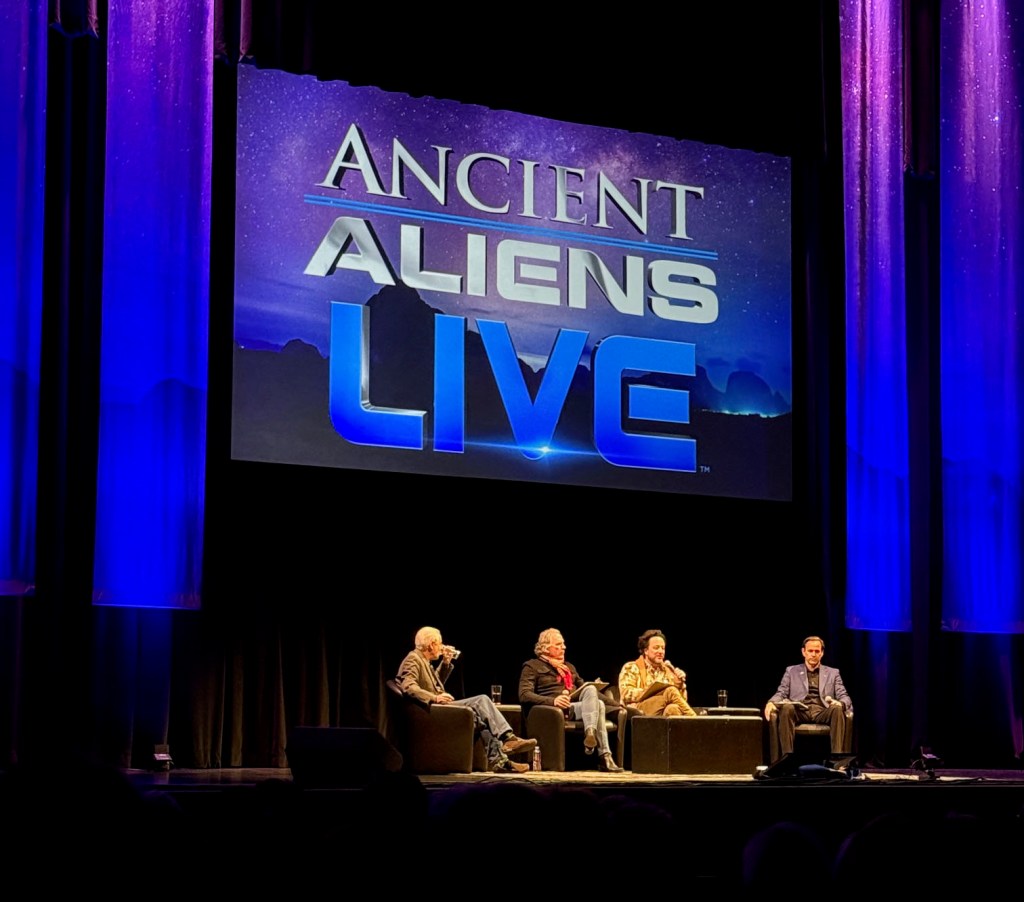
On a cold night in March 2025, we were fortunate to spend time with Nick Pope when he was in town for the Ancient Aliens Live Tour. A 90-minute experience celebrating the long-running History Channel show, Ancient Aliens Live was moderated by Nick and before the show, he generously sat down with us for a lively and insightful conversation about his career, ancient astronaut theories, his personal journey, his take on disclosure, and much more.
Sadly, a little over a year after we met with Nick, he departed this earth. We are grateful to have known him and feel fortunate to have shared in his story. Our conversation with Nick, transcribed below, was originally published in the Winter 2025/2026 issue of the Saunière Society Journal.

Lisa:
Thank you Nick for taking the time to sit down with us. Our audience is very unique. At its foundation, the Saunière Society is focused on the Rennes-le-Château mystery, but our members are also interested in all kinds of mysterious phenomena and history. UFOs have always been an interesting topic for our group, so we’re grateful to have this chance to talk with you.
I know you touched on it in Open Skies, Closed Minds, but prior to working for the Ministry of Defense, what were your feelings on UFOs, and were UFOs something that interested you before then?
Nick:
Not really. Like most kids, I’d probably seen Close Encounters of the Third Kind in the movie theatres when it came out, and I’d probably read Charles Berlitz’s The Bermuda Triangle, which I think had a chapter on UFOs. But aside from that—which is kind of what lots of teenagers did—no. I had no special interest in this subject and no particular beliefs.
Looking back, that was probably the best way to come into that job because I didn’t come in weighed down with any baggage in terms of preconceived ideas—whether as a true believer or a die-hard debunker. Going in somewhere in the middle, with a blank sheet of paper, meant I could take a more data-led approach and say, ‘Well, I’ll just see what happens.’
Lisa:
So when you first started, how did you get the UFO assignment?
Nick:
It was a little bit accident and a little bit luck—right place, right time. Civil Service posting policy was a bit of a dark art back then. They moved you around every two, three, four years—either on a level transfer or on promotion. I was due for a move, and this vacancy was coming up. I was already in that division, but in a different part of it.
Lisa:
What year was this?
Nick:
This was ’91. In August 1990, Saddam Hussein invaded Kuwait. Late 1990 into early 1991, they were looking for people—young junior managers, energetic people who didn’t mind doing twelve-hour shifts, sometimes overnight—working in the Joint Operations Centre as watchkeepers, briefers, whatever. I did that.
That’s how I got to know the particular manager who had the UFO job coming up. He said, ‘Nick, I know you’re due for a move, but instead of moving to another division, why don’t we manage with Personnel a little internal shuffle? You can get your move, I can get you—who I already know—and everyone wins.’ So I said yes. That’s pretty much how it happened.
Lisa:
What was your title at that point?
Nick:
The technical title was Secretariat Air Staff 2A—very intuitive. That’s why we used ‘does what it says on the tin’ descriptions: UFO programme, UFO desk, things like that, because you can’t keep saying, ‘I’m doing Secretariat Air Staff 2A’, Secretariat Air Staff was the name of the division, and 2A was my bit of it. It sounds like something out of a sci-fi movie—everyone’s got a number—but that’s what it was.
Lisa:
And did people take the job seriously? Did co-workers give you a hard time?
Nick:
Mixed. Our job was to look at this from a defence and national security point of view and ask: could any of this be technology from an adversary?
Lisa:
Usually Russia?
Nick:
Yes—Russia, historically. The geography and geopolitics mattered. Had they made some huge aerospace breakthrough? Could it be a new secret prototype aircraft or spy plane? That underpinned a lot of our thinking and the wider Cold War mentality. Even though the Wall had come down in ’89 and things were changing, it was still an uncertain time, and we knew there were still bad actors out there.
That being said, you can’t use the phrase ‘UFO’ without triggering all sorts of reactions. People would whistle the Twilight Zone theme at me as I walked down the corridor. And The X-Files started—about ’93—so I did the job 1991 to 1994, just as that was becoming a thing. I inevitably picked up the nickname ‘Spooky’.
Lisa:
As an X-Files fan, I find that fabulous. Did you embrace it?
Nick:
At first I was annoyed. It felt like it trivialised things. But then you realise you have to own it and roll with it. People aren’t being nasty. It’s workplace banter.
That’s one reason we changed the language from UFO to UAP: Unidentified Aerial Phenomenon. UAP was actually an old term. It had been used by the US government since the late ’40s but it had fallen out of use. We needed to rebrand the subject to get rid of the pop-culture baggage.
A colleague and I sat down in ’92 or ’93 and said. ‘We’re never going to get this taken seriously—not by our own people—if we keep using UFO.’ We wanted resources, we wanted it taken seriously by senior leadership, but you couldn’t get a meeting if you called and said, ‘I want to come talk about UFOs.’
But if you said, ‘I want to talk about UAP,’ they’d ask, ‘What’s UAP?’ And you’d say: ‘Unidentified Aerial Phe- nomenon. It’s a science and military issue. We’re not sure what we’re dealing with. Our pilots see them, radar operators track them, we’ve had near misses, and we need to do more.’ Then it’s, ‘Fine—come brief us.’ So you change the language to change the conversation.
Lisa:
And you played a big role in changing that conversation.
Nick:
Yes. And there’s a funny postscript. After I took early retirement from the MOD—around summer 2011—I got an email asking me to come to D.C. for a meeting. I lived in the UK at the time. I asked who it was with, and they said a range of fairly senior people with an interest in this field.
And I went. Someone who had been chief of staff to a former US president who chaired it. There was at least one former CIA director, and others from government, the military, and intelligence—mostly retired people who could meet with plausible deniability. I briefed them on what we did on the UFO desk and on the language change. They were more interested in the language change than anything else. I could see thegears turning.
I moved to the US permanently in January 2012. In 2016 I was flipping through channels and saw Hillary Clinton being interviewed on Jimmy Kimmel. Kimmel says, ‘I understand you’ve committed to release all the information on UFOs’, and she stops Kimmel and says, ‘Actually, there’s a new term—UAP.’ Then when it went mainstream in 2017—when The New York Times ran the story about AATIP and the US Navy videos on December 16, 2017—a Navy spokesperson was asked, ‘What’s with this UAP stuff?’ and he said, ‘We borrowed the term from the Brits.’ I thought,‘You’re welcome.’
I didn’t invent the term—it’s decades old—but I played a key role in changing the language inside the Ministry of Defence, and through that meeting, bringing it to the US to allow the topic to be discussed with more credibility. There’s no way many politicians would have touched this if it were still ‘UFOs’. Once it became ‘UAP’, and once it was framed as defence, national security, and safety-of-flight, they could say: ‘I want to know what’s in our skies. Is it Russia? China? Something else?’
Lisa:
Were you with that division the whole time you were at the MOD?
Nick:
No. That was one posting in a 21-year career. I was on the UFO desk 1991–1994. After that I did a financial policy job. Then a security job involving counter-terrorism, including a couple of short trips to places like Iraq—never military; I was a civilian. You can’t ‘deploy’ a civilian to a war zone, but if you’re foolish, you might go. It wasn’t a full shooting war by then, but counter-insurgency—be wary of IEDs, that sort of thing. Then I went to Kosovo and did interesting things completely unrelated to UFOs.
Lisa:
When you mention Iraq, I think of cradle-of-civilisation… and Ancient Aliens. On the show, you’re often commenting on the government/UAP side. How do you feel about the ancient astronaut theory side?
Nick:
It’s a good point. Ancient Aliens has evolved. It used to be very much ancient astronaut theory, but it couldn’t ignore what happened in 2017—the mainstreaming—because people like Giorgio take the view that these visitors never really went away. As the show changed to cover things like AATIP, the Navy videos, whistle blowers, I became a big part of that.
I’m not an expert in ancient astro-naut theory. There are people on the show who are: Giorgio Tsoukalos, William Henry, David Childress, Jason Martell, Linda Moulton Howe, Jonathan Young, Andrew Collins, Hugh Newman—lots of people. If I comment on those stories, it’s often as an on-screen narrator: ‘Ancient astronaut theorists believe…’ I can’t compete with people who’ve spent decades researching it. In tonight’s show, you’ll see I’m the moderator because I can’t compete on ancient astronaut theory.
Lisa:
But do you believe the ancient astronaut theories and narratives?
Nick:
I’m open to the possibility. When you listen to some arguments—like incredible construction we’d struggle with today—some of the physics, the engineering—it makes you wonder. Sites like Puma Punku and Sacsayhuamán: you see huge blocks that frankly look like they’ve been machine-tooled. Yet we’re told our ancestors had little more than copper/bronze tools.
Giorgio once explained it using the Mohs scale of hardness. Copper/bronze can cut sandstone, sure. But some stones are much harder—so how are they cut and fit with such precision? Some joints don’t even use mortar; you can’t fit a dollar bill between them.
Lisa:
And Baalbek?
Nick:
Yes—Baalbek in Lebanon. Some stones are talked about as being on the order of 1,000–1,500 tons, cut to within millimetres. Today you’d need diamond-tipped drills, power tools, water jets—yet we’re told they didn’t have that. Then you’ve got alignments of monuments with the Pleiades, Sirius, and mathema-tical information encoded in places like the Great Pyramid. You sometimes see modern recreations where they struggle even with 21st-century technology. That makes me wonder.
Also: rising sea levels since the end of the Ice Age. We build on coasts; what have we lost? Every now and then we hear of ‘lost cities’ found via satellite imagery or LiDAR. When I was a kid, we were told there was no civilisations older than the Sumerians—about 5,000 years. Then they found Göbekli Tepe, and suddenly it’s 12,000. So what next?
And if intelligent extraterrestrials visited, it’s not that ‘aliens built the pyramids,’ but we might have learned techniques or acquired some technology. Is it disparaging to say we had a teacher? Everyone has a teacher. Many cultures have legends of a teacher coming down, imparting agriculture, medicine, law, architecture, mathematics, geometry. And across cultures the origin stories rhyme: a teacher came, shared wisdom, not conquest. That’s intriguing. Maybe monuments commemorate those first teachers.
Lisa:
The show also talks about mining for resources—coming to take, not just to teach and that makes me think of our audience. There’s an episode of Ancient Aliens that mentions Rennes-le-Château—before your time—but focusing on the gold angle—on mining. And there are many reports and traditions related to UFOs in France. Did you work with the French government much? How did they approach UFOs/UAP?
Nick:
There was very little international cooperation—really, even in Europe. Everyone kept their cards close to their chest. The French are interesting, though. Many governments embed UFO programs in Defence or the Air Force. France is unusual because their UFO program is embedded in their national space centre. France has a body called GEIPAN (spelled G-E-I-P-A-N). It’s part of CNES (their national space agency), headquartered in Toulouse, I believe.
I met the French person who handled it later, privately—not during 1991–1994—but afterwards. Ex-government people who handled this subject sometimes stay in touch. The French guy was called Jacques. They have a website and have released quite a lot of information. But we didn’t work with them officially. I’ve not visited Rennes-le-Château. But—small spooky coincidence—I briefly dated Lynn Picknett.
Lisa:
You did?!
Nick:
Yes. I knew Clive and Lynn—we were in similar social circles. Lynn and I dated briefly; she’s lovely and fascinating. She told me a lot about Leonardo da Vinci, heretical messages, encoded artwork. I enjoyed their book, The Stargate Conspiracy. That book tied together ancient and modern strands. It looked at ideas like ‘the Nine’ and whether it connects to Egyptian gods, and you get films like Stargate, and then people joke ‘that’s a documentary’.
Lisa:
Exactly! And when you mention Stargate in that context, I think of the ways that science fiction and reality really do intersect. You’ve written science fiction novels and there’s a clear tradition of sci-fi writers being almost prescient. What role do you think sci-fi plays in how the world perceives UFOs/UAP and aliens?
Nick:
Science fiction is huge. First, it opens minds to possibilities and acclimatises people. If we get a big revelation—disclosure of an alien presence, or first contact—it will profoundly affect everything: politics, religion, science, tech-nology, daily life. We’ll remember before and after.
And there are many variables. It could be a War of the Worlds—invasion—or more thoughtful films like Contact and Arrival… Contact especially digs into the intersection of science and religion. Sci-fi lays foundations so it’s less of an ontological shock. And good sci-fi isn’t really about aliens—it’s about us and our reaction. That’s why Contact and Arrival are so good.
We might end up with worst-case invasion, or best-case: we take a seat at the table in the universe—‘United Federation of Planets’ style—and learn there’s more that binds us than separates us. Also, I sometimes speculate about convergent evolution: certain solutions might appear again and again. Legs work for getting around; arms/hands for building; eyes for seeing what you’re doing; vocalisation and written language to share knowledge; books and blueprints for technology.
And tech may converge too: airports might look like airports because fixed-wing flight needs runways—unless you’ve got anti-gravity. Wheels are wheels everywhere. So some things may look surprisingly familiar.
Lisa:
So do you think, in your lifetime, you’ll have the opportunity to fully disclose all of your work at the UFO desk?
Nick:
I wasn’t sitting on a ‘smoking gun’. If there are crashed UFOs and non-human intelligences and recovered technology, I wasn’t read into those programs. My suspicion is those would be US programs—if they exist—and that’s what people like Luis Elizondo, David Grusch, and others claim. We’ll see. In one sense it’s binary: it’s either true or it’s not. If it’s true, the momentum might be impossible to stop. But even if it’s not true—if aliens have never visited—it doesn’t mean they couldn’t visit tomorrow. We could have first contact without disclosure because there’s nothing to disclose yet. Or you could have a hybrid scenario where ancient astronaut theory is true and they return openly.
Lisa:
Agreed—and to continue that binary thread, are you up for a speed round? Simple options and no explanations?
Nick:
Okay.
Lisa:
Awesome. Let’s do it! First question: Best UFO/space movies?
Nick:
Contact and Arrival. Honourable mention: Close Encounters of the Third Kind. And maybe even The Day the Earth Stood Still—I like movies that make you think.
Lisa:
Top two UFO spots in the US?
Nick:
Roswell—has to be number one. And Area 51.
Lisa:
Top two UFO spots in the UK?
Nick:
Rendlesham Forest. And probably—going back decades—Warminster.
In the ’60s they had the ‘Warmin-ster Thing’, UFO sightings, but also other odd phenomena, strange sounds and buzzings.
Lisa:
Top UFO spot in the rest of Europe?
Nick:
Not sure. One that William sometimes talks about is Val Camonica, with strange petroglyphs.
Lisa:
Star Wars or Star Trek?
Nick:
Star Trek.
Lisa:
Doctor Who or Buck Rogers?
Nick:
Doctor Who.
Lisa:
Favourite Doctor?
Nick:
Tom Baker.
Lisa:
Grays or Alien? Like Sigourney Weaver-type aliens. What’s more likely?
Nick:
Honestly undecided. Some people think the Grays aren’t extraterrestrials but time travellers from the future—that’s why they look like us.
And in the original Giger work and the original Alan Dean Foster novelisation, the alien is described as bio-mechanical—interesting, especially given AI discussions today. As Ash says: a perfect organism… a perfect killing machine—an evolutionary pinnacle.
Lisa:
Implants or probings?
Nick:
[[Laughs for a moment …]] I’ll take an implant—for obvious reasons. Probing is to be avoided.
Lisa:
Mulder or Scully?
Nick:
Mulder, because people have called me the real Fox Mulder. But Scully is a hero. My wife is a scientist, a skeptic, and a redhead.
Lisa:
Love it! And that was a great speed round! Thank you for being such a good sport! Anything you wish we’d gotten to?
Nick:
For this audience, I’d say: I’m not an expert on ancient mysteries and lost knowledge, but one thing government teaches is: don’t believe in coincidence. There are very few coincidences. When you see a pattern, there’s likely a connection. Approach research with that in mind. Look for intersections be- tween fields that take you outside your comfort zone. And remember: treasure doesn’t have to be gold. Treasure can be knowledge and wisdom.
There’s a line in The X-Files: Mulder is in a railway carriage, and Scully asks, ‘Mulder, where are you?’ and he says, ‘Nowhere I ever expected to be.’ If your research takes you to nowhere you ever expected to be, that’s a good thing.
Lisa:
That’s such a meaningful way to finish this up Nick, especially for our audience.
Thank you, Nick, for your work in the field and thank you so much for doing this interview. We look forward to the show tonight!

 occulta thesauri